0%

A warehouse can look orderly at 8 a.m. and feel very different by mid-shift. Pallets crowd the travel lanes. Operators wait at a busy transfer point. One delayed move can leave a picking aisle short of stock. That is where an AGV Forklift may help—but only when its route, load capacity, and handoff points match the work.

Robotics researcher Henrik I. Christensen offers a useful principle for evaluating automation: technology should be designed around real human tasks. This is a paraphrase of his broader work, not a verbatim quotation. For warehouse teams, that means checking more than a vehicle’s headline speed. Fork dimensions, turning space, floor quality, traffic controls, charging routines, and integration with warehouse software all matter. A machine that performs well in a showroom may struggle beside a narrow rack or an uneven dock plate.

The ten models in this guide are compared through practical criteria: payload, navigation approach, operating environment, safety features, service support, and deployment needs. Details vary by site. They should be confirmed with each manufacturer and tested against actual routes. No ranking can replace a floor survey. Some specifications also hide trade-offs; that deserves a closer look. The right choice is not always the fastest forklift. It is the one that moves reliably, fits the workflow, and gives staff a clear way to intervene when conditions change.
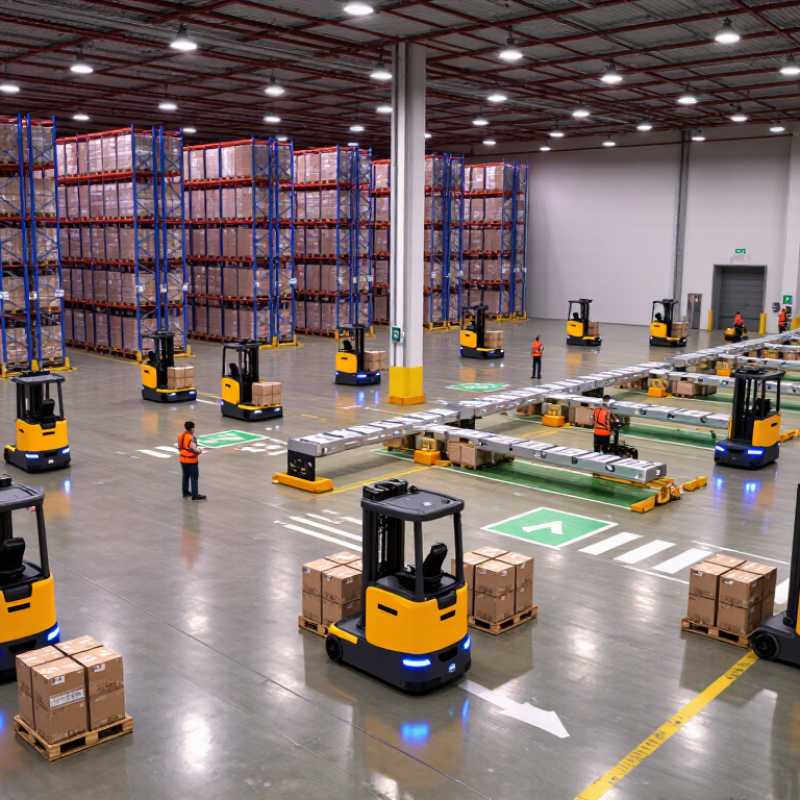
10 Best AGV Forklifts for Warehouses in 2026

How AGV Forklifts Work in Warehouse Operations

AGV forklifts move pallet loads through warehouse tasks using programmed routes and onboard control systems. Depending on the site, they may follow floor markers, magnetic guidance, or mapped routes read by laser sensors. A warehouse management system can send a job, such as collecting a pallet from a receiving lane and delivering it to storage. The vehicle checks its path, slows near obstacles, and positions its forks at the pickup point. No driver is onboard.

During a shift, fleet software assigns jobs and helps prevent vehicles from meeting in narrow aisles. Sensors monitor people, pallets, and other equipment, but they do not replace clear walkways or trained staff. Operators still need to plan charging, inspect forks, and respond when a load sits crooked. Small details matter. A slightly damaged pallet can disrupt a tidy automated route.

Before deployment, teams should map traffic patterns, test loads, and check turning space at racks and doorways. A route that works on an empty floor may fail during a busy receiving period. That part is easy to underestimate. AGVs can make repeated transport more consistent, but performance depends on floor condition, layout, and reliable handoffs between software and people.

Key Criteria for Evaluating AGV Forklifts in 2026

10 Best AGV Forklifts for Warehouses in 2026

Key Criteria for Evaluating AGV Forklifts in 2026

Evaluate each AGV forklift against the work it will actually perform, not a showroom demonstration. Record pallet weights, lift heights, aisle widths, floor joints, and peak moves per hour. A heavy load on smooth concrete says little about turning beside a dock plate. Check rated capacity at the required lift height; usable capacity may decrease as the mast rises. Small detail. Big difference.

Navigation must suit the warehouse’s real conditions. Test routes near reflective wrap, busy intersections, and temporary pallet stacks. Ask how the vehicle responds when a person or obstruction blocks its path. Safe stopping matters. So does recovery: repeated manual resets can quietly undermine productivity. Integration deserves equal scrutiny. Confirm that dispatch software can exchange task and status data with existing warehouse systems, and test the connection during a realistic shift.

Compare uptime claims with maintenance requirements, battery charging time, and access to replacement parts. Ask operators to inspect the forks, sensors, and emergency-stop controls during a trial. Listen for scraping on tight turns. It can reveal a layout issue, not just a vehicle issue. Calculate cost per completed move, including installation, training, service, and charging infrastructure. Estimates will still be imperfect; document assumptions and revisit them after a pilot.

AGV Forklift Load Capacity: Typical Ranges

Compare rated-load capacity ranges across common warehouse forklift types when evaluating AGVs for 2026. Actual capacity depends on the model, lift height, and load center.

Ranges are indicative general-purpose specifications, not a market survey or a guarantee for any particular AGV. Confirm rated capacity on the individual truck’s data plate and specification sheet.

Ten Leading AGV Forklifts for Warehouses in 2026

In 2026, the best AGV forklift depends on the load, aisle width, floor condition, and shift pattern. A useful shortlist compares capacity, lift height, navigation method, and charging needs—not just travel speed. Ten leading configurations offer different warehouse strengths; none suits every site.

A counterbalanced forklift handles mixed pallets and dock work. A reach truck serves high racks in narrower aisles. A pallet truck moves loads at floor level. A walkie stacker suits short, lower-volume trips. A turret truck accesses tall storage in very narrow aisles. A double-deep reach truck increases rack density, with some access trade-offs. A clamp-equipped AGV handles stable, suitable non-palletized loads. A fork-over stacker can lift pallets without conventional straddle legs. A load-transfer forklift supports conveyor or production handoffs. An outdoor-rated forklift may suit sheltered yards, if the surface is suitable.

Before choosing, measure the tightest turning point and test representative loads. Check whether the AGV can identify damaged pallets, cope with floor joints, and pause safely around people. Ask for route trials during busy periods, not only an empty-floor demonstration. Battery performance can disappoint when charging windows are poorly planned. That matters. Rankings are imperfect: a compact pallet truck may outperform a taller machine in a fast-moving, low-rack facility. The right comparison starts with real traffic and load data.

10 Best AGV Forklifts for Warehouses in 2026 - Ten Leading AGV Forklifts for Warehouses in 2026

AGV forklift type Typical rated load range Typical lift range Common navigation options Best suited for Key selection consideration
Automated pallet truck About 1,000–2,500 kg Floor-level pallet handling; typically around 100–200 mm fork lift Laser, natural-feature, or magnetic guidance Pallet transport between docks, staging areas, and production lines Check pallet entry clearance, floor condition, and transfer-point layout.
Automated pallet stacker About 500–1,600 kg Approximately 1.6–5.5 m, depending on configuration Laser, natural-feature, or reflector-based guidance Low- to medium-height pallet storage and replenishment Confirm residual capacity at the required lift height and load center.
Automated counterbalance forklift About 1,000–5,000 kg Approximately 3–7 m Laser, natural-feature, or reflector-based guidance Mixed indoor routes, dock work, and handling loads that require free-standing forks Allow for turning space, pedestrian separation, and safe dock transitions.
Automated reach truck About 1,000–2,500 kg Approximately 6–12 m Laser or natural-feature navigation High-bay pallet storage in narrow warehouse aisles Verify aisle width, rack clearances, and load capacity at maximum height.
Automated very-narrow-aisle (VNA) turret truck About 1,000–1,500 kg Approximately 10–15 m for suitable configurations Wire guidance, laser guidance, or other aisle-guidance systems High-density storage where dedicated narrow aisles are available Requires carefully engineered aisle geometry, floor flatness, and rack tolerances.
Automated double-deep reach truck About 1,000–2,000 kg Approximately 6–11 m Laser or natural-feature navigation Facilities using double-deep racking to increase pallet positions Assess access requirements and the effect of deeper storage on selectivity.
Automated straddle forklift About 500–1,500 kg Typically up to around 3–5 m Laser, natural-feature, or magnetic guidance Pallet stacking and handling loads with compatible entry openings Check that the straddle legs and fork arrangement match pallet and load dimensions.
Automated side-loading forklift About 1,000–3,000 kg Approximately 3–7 m, depending on design Laser or natural-feature navigation Long loads such as timber, pipes, or profiles handled along narrow routes Route width and load length are critical; confirm turning and crossing requirements.
Automated multi-directional forklift About 1,000–3,000 kg Approximately 3–8 m, depending on configuration Laser or natural-feature navigation Long-load storage and operations that benefit from lateral travel Validate travel modes, load stability, and floor conditions across the full route.
Automated tow tractor with load-handling attachment Typically rated by towing capacity; commonly around 2,000–6,000 kg total train load No fork lift; carts or trailers carry the loads Laser, natural-feature, magnetic, or marker-based guidance Repeated material runs using carts between warehouse and production areas Size routes for the full train and confirm coupling, braking, and trailer compatibility.

Note: Capacity and lift figures are broad, indicative ranges for equipment categories, not specifications for a particular model. Actual performance varies by configuration, load center, mast, battery, floor conditions, and operating environment. Confirm requirements with the equipment supplier and conduct a site assessment before selection.

Comparing Models by Capacity, Navigation, and Safety

Choosing among ten warehouse AGV forklifts starts with the load, not the headline speed. Compare rated capacity, load center, fork dimensions, and turning radius against real pallets. A nominal two-ton rating can mislead if loads are long, uneven, or handled on sloped floors. Small details matter.

IFR’s World Robotics 2024 report recorded 113,000 transport and logistics robots sold in 2023, a 35% year-over-year increase. That growth signals wider adoption, but it does not prove every warehouse needs the same navigation system.

Laser-based navigation can adapt to changing layouts, while magnetic tape or floor markers may suit stable routes. Test each candidate around tight rack ends, reflective wrap, and busy crossings; clean demo floors hide problems. Compare recovery behavior after blocked aisles, too. ISO 3691-4:2020 sets safety requirements for driverless industrial trucks and their systems, including protective measures.

Ask how each forklift detects people, slows near blind corners, and stops when a scanner is obstructed. Not always obvious. A safety field that works in an open aisle may need adjustment near rack legs. The uncomfortable part: higher capacity and faster travel can increase risk if traffic rules and pedestrian routes remain unchanged. Probe those trade-offs before ranking models.

Matching AGV Forklifts to Warehouse Layouts and Workflows

An AGV forklift should fit the warehouse, not force the warehouse to adapt. Measure aisle width, turning space, rack clearance, and floor condition before comparing models. A narrow-aisle reach truck may work well beside tall racking, while a counterbalance model needs more room to turn. Check pallet sizes, too. Uneven loads can change how safely a vehicle lifts and travels.

Small details matter. A busy receiving area may need counterbalance forklifts for unloading, while pallet stackers suit short moves near low racks. For repeat routes between production and storage, a tugger-style AGV can move several carts in one trip. Match the vehicle’s rated capacity to the heaviest real load, not the average. Also review traffic crossings, pedestrian routes, charging access, and how the system handles blocked paths.

Workflow matters as much as layout. Map how often loads move, where queues form, and which tasks still require a person. Ask suppliers to test a representative route with actual pallets and shift schedules. Track pickup delays, missed handoffs, and battery use during the trial. I would not treat a clean demo as proof of reliable performance; real shifts are messier. Some routes may need redesign before automation pays off.

FAQS

How does an AGV forklift move pallets through a warehouse?

It follows floor markers, magnetic guidance, or mapped routes read by laser sensors. Software sends pickup and delivery tasks. No driver rides onboard.

What safety features and staff practices are needed?

Sensors monitor people, pallets, and equipment, then slow or stop for obstacles. They do not replace trained staff or clear walkways. Clear paths matter.

What should happen when a route is blocked?

The vehicle should respond safely, but teams should check how it recovers. Repeated manual resets can reduce productivity. Test this during a realistic shift.

How should a warehouse check an AGV forklift’s capacity?

Compare its rated capacity with the heaviest real pallet and required lift height. Usable capacity may decrease as the mast rises. Small detail. Big difference.

Which warehouse measurements affect vehicle choice?

Measure aisle width, turning space, rack clearance, floor condition, and pallet sizes. A narrow-aisle model may suit tall racks, while other vehicles need more turning room.

What should a trial include?

Use actual pallets, real routes, and representative shift schedules. Test near reflective wrapping, busy crossings, and temporary pallet stacks. A clean demo proves little.

How can a warehouse compare operating costs?

Estimate cost per completed move, including installation, training, service, and charging infrastructure. Record assumptions. They may be imperfect.

Can every warehouse route be automated as it is?

Not always. Some routes may need redesign around queues, handoffs, or tight turns. I would not assume automation fixes a messy workflow.

Conclusion

This guide explains how an AGV Forklift supports warehouse operations, from moving pallets between storage areas and workstations to following programmed routes with minimal manual intervention. It outlines the main factors to consider when evaluating equipment in 2026, including load capacity, navigation methods, safety features, charging needs, and compatibility with existing systems. The goal is to help readers compare options according to practical requirements rather than focus on a single feature.

The article also reviews ten leading types of warehouse AGV forklifts and compares their capacities, navigation approaches, and safety capabilities. Because no two facilities operate in exactly the same way, it explores how aisle width, floor conditions, traffic patterns, storage design, and daily workflows can influence equipment selection. By matching these considerations to a warehouse’s layout and tasks, businesses can identify solutions that support efficient, reliable material handling.

Elowen

Elowen

Elowen is a professional marketing specialist with a strong understanding of the company’s products and the needs they are designed to address. She regularly contributes expert articles to the company website, turning product knowledge and industry insights into clear, useful guidance for readers.......